

RAG and Context Engineering: Designing and Building Production-Grade AI Systems
Design retrieval-aware AI systems for real-world deployment
Program Overview: RAG and Context Engineering
Organizations today increasingly need experts who can architect and strengthen artificial intelligence (AI) systems against inconsistent outputs, security vulnerabilities, and performance bottlenecks. In eight weeks, this program builds expertise in evaluation discipline, system auditing, retrieval-augmented generation (RAG) design, and the core principles that determine whether LLM systems succeed or fail in production. Through faculty-led live online sessions, guided labs, applied exercises, and a capstone project that requires you to build and evaluate a production-grade system end to end, the curriculum takes you from understanding the mechanics of LLMs to designing retrieval-augmented systems built for accuracy and safety.
95%
~25%
Key Takeaways: RAG and Context Engineering
Decide when and why external retrieval is necessary in LLM systems
Design classical, semantic, and hybrid retrieval pipelines
Diagnose accuracy and performance failures using structured evaluation
Build end‑to‑end RAG systems and advanced multihop retrieval pipelines
Implement retrieval‑aware agentic workflows for multistep reasoning
Deploy secure and observable production‑grade RAG systems
Applied Learning: Real-World System Design
Guided lab sessions
Work through complex system-building challenges for one of two provided scenarios, with real-time guidance in virtual lab sessions. Stress-test your understanding of key concepts, ask questions in context, and consolidate your learning before applying it independently to the capstone project.
LLM interfaces and model ecosystems
Experiment with leading LLM interfaces, including ChatGPT, Claude, and Gemini, to compare outputs, test behaviors, and understand model limitations. Use unified access layers, including OpenRouter, to explore how different models perform across tasks.
API-based model access
Gain experience working with LLM APIs, such as OpenAI API, to build structured workflows involving retrieval, chaining, and system design. Learn to generate and manage API keys as part of the implementation
Python-based development
Work within Python environments to implement, test, and iterate on system components. Extend your workflows using development tools, including VS Code and GitHub, to support reproducibility and version control.
Who Is the RAG and Context Engineering Program For?
This MIT xPRO program is designed for technical professionals who are building, deploying, or scaling LLM applications and want to design production-grade AI systems that are accurate, reliable, and context-aware.
It is especially beneficial for:
AI and machine learning engineers
Software engineers, full-stack developers, and backend engineers
Platform, infrastructure, ML platform, and MLOps engineers
Data scientists, solution architects, and technical product managers
This program is relevant for professionals seeking to strengthen their ability to:
Design reliable and context-aware LLM applications for real-world use cases
Build modern AI architectures incorporating retrieval, agentic workflows, and evaluation
Evaluate, diagnose, and improve LLM system performance using structured frameworks
Move beyond prototypes to deploy secure, scalable, and observable AI systems
Prerequisites: Participants must have a functional knowledge of Python, application programming interfaces (APIs), and AI/ML concepts.
Program Highlights

Future-Facing Skills

Live Online Sessions by MIT Faculty

Applied, Hands-On Learning

Capstone Project

Tools and Frameworks

Virtual Labs with Learning Facilitators

Global Peer Networking

Certificate of Completion
What You Will Learn
Across eight weeks of virtual labs and faculty-led live sessions, the curriculum helps you advance from working with LLMs to building retrieval‑aware systems that integrate information retrieval, enabling accurate, context-aware outputs grounded in external knowledge. The program concludes with a capstone project based on designing your own retrieval-aware LLM system.
Week 1: Foundations of LLMs for Retrieval-Aware Systems
Week 2: Retrieval Foundations: From Basic Lookup to Vector Search
Week 3: Measuring What Matters: Evaluation before Optimization
Week 4: Advanced Retrieval: Multihop and Graph-Based Systems
Week 5: RAG Architectures and Agentic Workflows
Week 6: Engineering Robust Retrieval-Augmented Systems
Week 7: Designing for Production: Cost, Security, and Reliability
Week 8: Capstone — Building and Diagnosing a Production-Grade RAG System
Note: The program includes a one‑week orientation preceding the eight weeks of curriculum.
Live Sessions with MIT xPRO Faculty - Schedule
Session | Day | |
|---|---|---|
Week 1: Foundations of LLMs for Retrieval-Aware Systems | Live Session 1 Virtual Lab 1.1 Virtual Lab 1.2 | Wednesday, November 4, 2026 Thursday, November 5, 2026 Friday, November 6, 2026 |
Week 2: Retrieval Foundations: From Basic Lookup to Vector Search | Live Session 2 Virtual Lab 2.1 Virtual Lab 2.2 | Wednesday, November 11, 2026 Thursday, November 12, 2026 Friday, November 13, 2026 |
Week 3: Measuring What Matters: Evaluation before Optimization | Live Session 3 Virtual Lab 3.1 Virtual Lab 3.2 | Wednesday, November 18, 2026 Thursday, November 19, 2026 Friday, November 20, 2026 |
Week 4: Advanced Retrieval: MultiHop and Graph-Based Systems | Live Session 4 Virtual Lab 4.1 Virtual Lab 4.2 | Wednesday, November 25, 2026 Thursday, November 26, 2026 Friday, November 27, 2026 |
Week 5: RAG Architectures and Agentic Workflows | Live Session 5 Virtual Lab 5.1 Virtual Lab 5.2 | Wednesday, December 2, 2026 Thursday, December 3, 2026 Friday, December 4, 2026 |
Week 6: Engineering Robust Retrieval-Augmented Systems | Live Session 6 Virtual Lab 6.1 Virtual Lab 6.2 | Wednesday, December 9, 2026 Thursday, December 10, 2026 Friday, December 11, 2026 |
Week 7: Designing for Production: Cost, Security, and Reliability | Live Session 7 Virtual Lab 7.1 Virtual Lab 7.2 | Wednesday, December 16, 2026 Thursday, December 17, 2026 Friday, December 18, 2026 |
Week 8: Capstone—Building and Diagnosing a Production-Grade RAG System | Virtual Lab 8.1 Virtual Lab 8.2 | Monday, January 4, 2027 Tuesday, January 5, 2027 |
Note: All sessions are held from 11:00 AM to 12:30 PM ET. Live session and virtual lab session timings are subject to change.
All virtual lab sessions are conducted by learning facilitators.
Capstone Project: Build a RAG LLM System
The program includes a capstone project in which you design, implement, and present a retrieval-augmented LLM system from the ground up. Beginning with either of two predefined scenarios, you will design and implement a retrieval‑augmented LLM system incrementally across modules, applying each concept directly to your system. You will progress through building and diagnosing system behavior, evaluating trade-offs, and justifying design decisions related to accuracy, cost, reliability, and security.
At the end of the program, you will present your finished RAG AI system, along with the reasoning behind your design choices and fine-tuning informed by peer feedback. You will also possess:
A working retrieval‑augmented system
A clear understanding of why it succeeds or fails
The ability to explain system behavior to technical and nontechnical stakeholders
Meet the Faculty

Armando Solar-Lezama
Distinguished Professor of Computing; MIT Schwarzman College of Computing; Associate Director and Chief Operating Officer, MIT CSAIL
Armando Solar-Lezama has been a faculty member at MIT since 2008 and has served as an associate director of the MIT CSAIL since 2020. He leads the Computer-Aided Programming G...
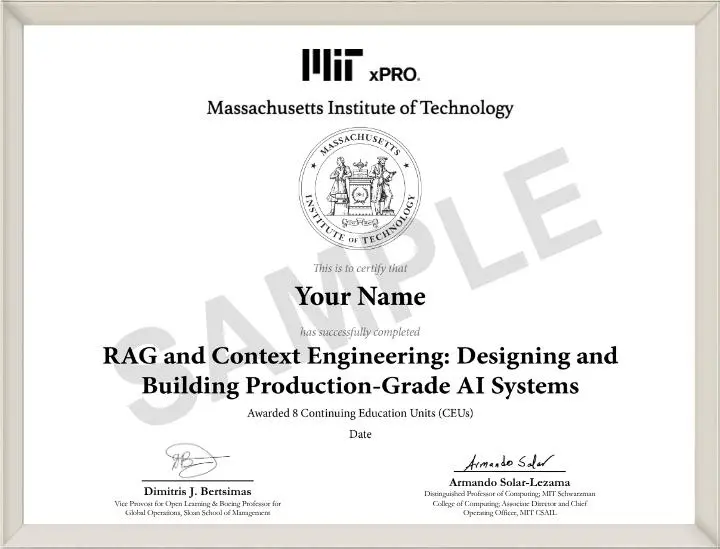
Certificate
Upon successful completion of this program, MIT xPRO grants you a digital certificate of completion and 8 Continuing Education Units (CEUs), a globally recognized measure of professional learning that reflects compliance with international quality standards.
This program is graded as complete or incomplete; participants must receive 80% or higher to pass and obtain the certificate of completion.
Notes:
After the successful completion of the program, verified digital certificates will be emailed to participants, at no additional cost, with the name used when registering for the program
All certificate images are for illustrative purposes only and may be subject to change at the discretion of MIT xPRO
Why MIT xPRO?
Founded in 1861, the Massachusetts Institute of Technology (MIT) is recognized globally as a leader in technology, AI, and innovation, driving industry transformation through groundbreaking research and real-world application. Ranked #1 in Forbes America’s Top Colleges list, MIT has built a legacy of excellence in academic rigor, pioneering discoveries, and cross-disciplinary collaboration. MIT xPRO brings this expertise to professionals worldwide, offering executive-level programs that translate cutting-edge research into practical frameworks for leadership, innovation, and impact in a technology-driven world.
Frequently Asked Questions (FAQs)
What is this LLM and RAG course about?
The RAG and Context Engineering: Designing and Building Production-Grade AI Systems program from MIT xPRO focuses on building retrieval‑aware LLM systems. The eight-week live online curriculum teaches you how to design, evaluate, and deploy RAG architectures that produce accurate and reliable outputs grounded in external knowledge sources.
Who is this AI course designed for?
MIT xPRO’s RAG and Context Engineering program is intended for technical professionals who want to build or oversee production-grade LLM systems with various retrieval methods and move beyond basic knowledge of simple prototypes.
Is this artificial intelligence program self-paced or live?
The program includes live online sessions and virtual guided labs along with hands-on programming assignments and other applied learning components. It therefore differs from learning at your own pace.
What topics are covered in this artificial intelligence program?
In this eight-week learning journey, you will learn RAG system design end to end, along with information retrieval strategies, how to compare retrieval methods, vector search, embedding models, semantic search, evaluation frameworks, and RAG applications.
What roles do embeddings play in the program?
The RAG and Context Engineering program covers how embedding models and word embeddings enable vector search and improve the retrieval of relevant information.
Are vector databases part of the curriculum?
The program explores how vector databases are used to store and retrieve relevant documents efficiently in RAG systems.
Will I build my first RAG system in this program?
The program’s hands-on capstone project requires you to build a retrieval-aware LLM system, applying your learnings on how to connect LLMs with knowledge bases, retrieve documents, construct retrieved context, improve response quality, and design AI systems that generate relevant responses in real-world scenarios.
What kind of data, datasets, and use cases are included?
You will work with realistic datasets and practical system design scenarios, building and evaluating retrieval-based systems that use structured data and external context. Throughout the program, you will apply these concepts to domain-specific use cases, including internal tools and domain-specific chatbot systems that generate accurate, context-aware responses.
Will I gain experience with production systems, open-source LLMs, and AI deployment choices?
The program learning journey includes building systems with production-ready components, exploring model selection, and working with open-source LLMs and API-based access to models. You will also learn how RAG becomes a core part of scalable LLM applications. Throughout the program, you will explore how to design and evaluate LLM-powered systems using production-relevant concepts, including model selection, cost and performance trade-offs, and different approaches to accessing models (e.g., APIs and open-source options). You will also examine how RAG supports building more reliable and adaptable LLM applications.
How does Emeritus support accessibility for learners?
Emeritus is committed to making high-quality education accessible and affordable to individuals, companies, and governments around the world. If you have questions about accessibility or would like to discuss available support options before enrolling, please contact accessibility@emeritus.org. For more information about our accessibility practices, please review our Accessibility Policy here.
Financing Options
Climb Credit*
We offer financing options with our partner, Climb Credit*. Click here to learn more.
Flexible Payment Options For All
Flexible payment options allow you to pay the program fee in installments. Click here to see payment schedule.
Didn't find what you were looking for? Write to us at learner.success@emeritus.org or Schedule a call with one of our Academic Advisors or call us at +1 401 443 9591 (US) / + 44 189 236 2347 (UK) / +65 3129 7174 (SG)
Flexible payment options available.
Starts On