

Predictive Artificial Intelligence
Program Overview: Predictive Artificial Intelligence
The eight-week Predictive Artificial Intelligence program from MIT xPRO equips professionals with the practical skills to apply predictive AI to solve real business problems.
Organizations that harness the power of predictive analytics are outperforming their competitors by making smarter decisions, anticipating market trends, and enhancing customer experiences. In this experiential program, you will work through the full analytics workflow, from data collection and preparation to building, training, and deploying predictive analytical models. Additionally, you will explore key techniques such as feature engineering, regression, and classification through real-world cases, including credit card fraud detection. By the end of the program, you will be equipped to communicate results clearly, build stakeholder trust, and lead impactful, data-driven initiatives in your organization.
Key Takeaways
This program offers practical training in predictive AI, teaching you how to build and evaluate models using advanced tools and techniques. You will learn to make data-driven decisions, communicate insights to nontechnical audiences, and directly apply AI methods to solve real-world business challenges and enhance outcomes.
Define predictive analytics and explain its benefits for business development and administration
Identify the fundamental data types for predictive analytics and how to collect, prepare, and analyze data
Build and evaluate predictive analytics models using popular tools, techniques, and forecasting methods
Apply predictive analytics to solve real-world business problems
Who Is the Predictive Artificial Intelligence Program For?
The MIT xPRO Predictive Artificial Intelligence program is ideal for:
Mid-level to senior professionals in roles such as data science, analytics, business intelligence, product innovation, and technology leadership/consulting across industries, including finance, healthcare, retail, technology, and manufacturing
Tech leaders, data engineers, and analysts seeking to upskill or pivot into AI-driven roles
Data scientists and data engineers looking to integrate predictive analytics and AI into their workflow
Business intelligence analysts wanting to move from traditional reporting to more advanced predictive modeling
Tech and product managers overseeing data-driven products who want to understand predictive capabilities
Founders, chief technology officers, or chief data officers seeking to lead AI transformation within their organizations
What You Will Learn in the Predictive Artificial Intelligence Program
Module 1: An Introduction to Predictive AI
Data and Its Role in Predictive AI
People and Their Roles in Predictive AI Development
Building Predictive AI, Step by Step
Challenges and Pitfalls
Looking Ahead
Module 2: Mapping a Business Outcome to Predictive AI
Action-Driven Predictive Model Creation
How to Systematically Perform the Outcome-First Approach
Case Study: Predictive AI for Fraudulent Bank Card Transactions
A New Role Emerges to Connect Business Outcomes to Predictive AI Endeavors
Module 3: Data to AI: Prediction Engineering
How Big Data Collection Has Brought Data Preparation Front and Center
What Is Data Preparation?
Prediction Engineering: What Is It, and How Is It Done?
Case Study: Online Course Stop-Outs
Module 4: Data to AI: Feature Engineering
Introduction to Feature Engineering
Defining Features
Automated Feature Engineering
Case Study Continued: Bank Fraud
Key tools used in this module include:
Featuretools
Pandas
Module 5: Data to AI: Modeling
Supervised Learning
Training a Predictive Model
The Quest for Better Models
Model Analysis
Analyzing Models for Insights
Key tools used in this module include:
scikit-learn
Module 6: Deploying Predictive AI
The Technical Aspects of Deploying a Predictive Model
Setting Up Deployment
Rolling Out and Monitoring Deployment
Deploying a Predictive AI Model Within Human Decision-Making Workflows
Developing an Explainable Decision Support System
Key tools used in this module include:
Pyreal
XGBoost
Module 7: Anomaly Detection
What Is a Time Series?
What Is Time Series Anomaly Detection, and How Is It Utilized?
Time Series Anomaly Detection Using AI/ML — a Primer
Developing Your Own Custom Generative AI Model
Evaluation
Key tools used in this module include:
Orion
Module 8: How to Develop a Predictive AI Project Road Map
Initiating a Project
Assessing Whether You Have Data for the Project
Forming a Team
Metrics and KPIs
Understanding Deployment Requirements
Determining the Tools You Will Need
Meet the Faculty

Kalyan Veeramachaneni
Principal Research Scientist, MIT Schwarzman College of Computing
In 2015, Kalyan Veeramachaneni founded MIT’s Data to AI Lab (DAI) (part of MIT’s Laboratory for Information and Decision Systems), leading a team focused on big data, human i...
Why MIT xPRO?
The Massachusetts Institute of Technology (MIT) is recognized globally as a leader in technology, AI, and innovation, driving industry transformation through groundbreaking research and real-world application. Founded in 1861 and ranked #1 in Forbes America’s Top Colleges list, MIT has built a legacy of excellence in academic rigor, pioneering discoveries, and cross-disciplinary collaboration. MIT xPRO brings this expertise to professionals worldwide, offering executive-level programs that translate cutting-edge research into practical frameworks for leadership, innovation, and impact in a technology-driven world.
Program Highlights

Learn by Doing
Practice processes and methods through simulations, evaluations, case studies, and tools.

Learn from Others
Connect with an international community of professionals while working on projects based on real-world examples.

Learn on Demand
Access all content online and watch videos at your own pace — anytime, anywhere.

Reflect and Apply
Apply your newly acquired skills in your organization, using examples from technical working environments and informed, practical advice.

Demonstrate Your Success
Earn a professional certificate and 4.8 continuing education units (CEUs).

Learn from the Best
Gain insights from MIT faculty and industry experts.
What Will You Walk Away With?
You will gain the skills to leverage machine learning for strategic decision making and achieving business goals. By the end of the program, you will be able to:
Define and apply predictive AI using various data types and assemble skilled teams to develop models based on key steps to solve real-world challenges
Establish KPIs to guide predictive AI initiatives and align business goals with AI solutions by creating a comprehensive predictive AI requirements document
Apply prediction engineering techniques to build models and extract data for practical applications by using tools such as Featuretools and Pandas
Convert raw data into features to boost model accuracy with automated and human-driven engineering and use Featuretools to streamline this process
Use supervised learning methods to build predictive models using hyperparameters while evaluating models and interpreting results with scikit-learn, XGBoost, and Pyreal
Explore data anomaly detection and apply it across sectors using unsupervised learning methods and tools such as Orion, boosting model accuracy and efficiency
Analyze and evaluate AI models in terms of time, resources, and cost and track deployment progress with tools such as SHapley Additive exPlanations (SHAP) and Pyreal
Assemble data experts, stakeholders, and bridge roles for collaboration in predictive AI projects with data assessments, success metrics, and scaling tools
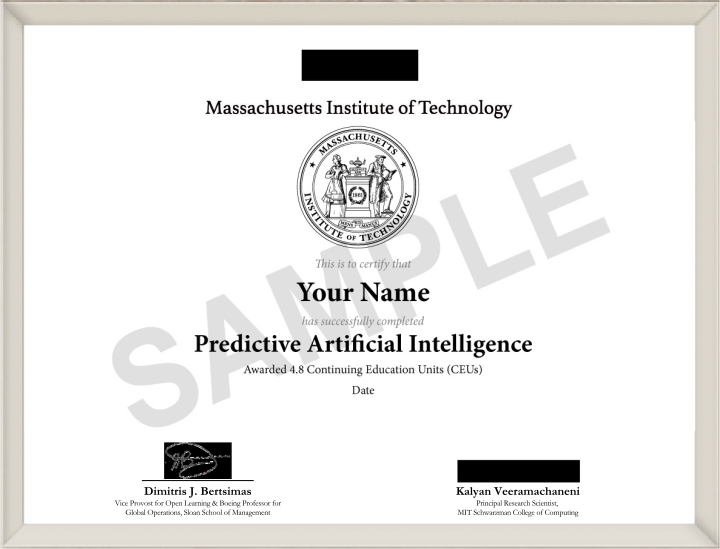
Certificate
Get recognized! Upon successful completion of this program, MIT xPRO will grant you a certificate of completion and 4.8 CEUs. This program is graded as a pass or fail; you must receive 70% to pass and obtain the certificate of completion.
After successful completion of the program, your verified digital certificate will be emailed to you, at no additional cost, in the name you used when registering for the program. All certificate images are for illustrative purposes only and may be subject to change at the discretion of MIT xPRO.
FAQs
What is the Predictive Artificial Intelligence program?
The Predictive Artificial Intelligence program from MIT xPRO is an eight-week predictive AI program designed to help professionals understand how predictive AI models are developed and applied to business challenges. This predictive AI program combines online learning, case studies, tools, and practical exercises covering data preparation, feature engineering, machine learning models, anomaly detection, and AI deployment.
What is a predictive analytics program, and what will I learn?
A predictive analytics program focuses on using data, models, and analytical techniques to generate insights and support decision making. In MIT xPRO’s Predictive Artificial Intelligence program, you will learn a data-to-AI approach for transforming business outcomes into predictive AI systems. You will explore the predictive AI workflow, including data collection, prediction engineering, feature engineering, model building, evaluation, and deployment. The curriculum also covers tools such as Pandas, Featuretools, scikit-learn, Orion, XGBoost, and Pyreal.
Who is the predictive analytics program designed for?
MIT xPRO’s Predictive Artificial Intelligence program is designed for mid-level to senior professionals, including data analysts, data science professionals, business intelligence professionals, technology leaders, and product managers. This predictive analytics program may also be relevant for professionals looking to build key skills in predictive modeling, strengthen their technical knowledge, and understand how predictive AI can support data-driven initiatives.
How can I learn predictive analysis through this program?
The Predictive Artificial Intelligence program from MIT xPRO provides a structured learning path across eight modules, from understanding predictive AI fundamentals to developing a predictive AI project road map. Participants of this Predictive Artificial Intelligence program engage with simulations, evaluations, case studies, online content, and activities based on real-world examples while learning to apply predictive analytics techniques to business problems.
Is predictive analysis hard to learn?
The difficulty of learning predictive analysis depends on your background, technical experience, and learning goals. MIT xPRO’s Predictive Artificial Intelligence program introduces concepts through a structured approach that connects data analysis, machine learning techniques, and practical applications. Through structured modules and applied learning methods, participants of this predictive artificial intelligence program explore topics such as regression, classification, feature engineering, model evaluation, and deployment.
Is it worth it to get a certificate in predictive analytics?
The value of a predictive analytics certificate program depends on your professional goals and the skills you want to develop. MIT xPRO’s Predictive Artificial Intelligence program provides exposure to predictive AI workflows, practical applications, faculty insights, and real-world cases. Upon successful completion, participants receive a certificate of completion from MIT xPRO and 4.8 CEUs.
How does Emeritus support accessibility for learners?
Emeritus is committed to making high-quality education accessible and affordable to individuals, companies, and governments around the world. If you have questions about accessibility or would like to discuss available support options before enrolling, please contact accessibility@emeritus.org. For more information about our accessibility practices, please review our Accessibility Policy here.
Financing Options
Climb Credit*
We offer financing options with our partner, Climb Credit*. Click here to learn more.
Flexible Payment Options For All
Flexible payment options allow you to pay the program fee in installments. Click here to see payment schedule.
Didn't find what you were looking for? Write to us at learner.success@emeritus.org or Schedule a call with one of our Academic Advisors or call us at +1 401 443 9591 (US) / + 44 189 236 2347 (UK) / +65 3129 7174 (SG)
Flexible payment options available.
Starts On