


Generative AI Playbook: Tools, Real-World Applications, and Governance
Leverage generative AI to navigate, apply, and govern emerging AI tools
Program Overview: Generative AI Playbook: Tools, Real-World Applications, and Governance
Generative AI Playbook: Tools, Real-World Applications, and Governance is a six-week online program from MIT xPRO designed for professionals who need disciplined, real-world judgment in generative artificial intelligence (gen AI). These technologies, AI and gen AI, are reshaping how organizations create value, enhancing productivity, influencing customer experiences, and redefining operational efficiency across industries. As a result, leaders are increasingly expected to evaluate their potential despite limited visibility into how these systems actually operate. This program builds the clarity required to assess how gen AI functions in practice, where its limits lie, and how responsible deployment should be governed.
The curriculum explores the foundations of generative models, machine learning (ML), and reinforcement learning, applying these concepts to real-world industry contexts. You will examine how large language models (LLMs), retrieval-augmented generation (RAG), and emerging AI agents, and agent-like workflows can influence modern AI workflows while addressing ethical considerations, AI governance, and responsible AI principles, and long-term societal impact. Through applied case analysis and structured frameworks, you will develop the fluency to evaluate applications of generative AI, engage credibly with technical teams, and design informed, responsible solutions for an evolving landscape.
By the end of the program, you will be able to:
Navigate the gen AI landscape and distinguish between generative models, machine learning (ML), and reinforcement learning
Apply image and text generative models to real-world business challenges
Leverage natural language processing (NLP) techniques to extract insights and solve practical problems
Assess ethical risk, bias, and governance issues in AI systems with confidence
Identify AI opportunities in areas such as fraud detection or predictive maintenance and develop practical solutions
Design and present a responsible gen AI solution tailored to a real challenge in your domain
Who Is the Generative AI Playbook: Tools, Real-World Applications, and Governance Program For?
The program is for professionals who want to make the most of gen AI to enhance their impact and effectiveness. As expectations rise for using gen AI at work, many are asked to integrate this technology into decisions and workflows without fully understanding how it functions or where it creates real value. This program equips you with the knowledge to apply gen AI confidently and responsibly in your role.
A few examples of who could benefit include:
Professionals who are being asked to leverage gen AI in their roles and want greater confidence in using it effectively, understanding where it adds value, and applying it responsibly
Executives and leaders who want to engage with gen AI thoughtfully and confidently, even if their technical knowledge is limited, and who are responsible for evaluating, influencing, or guiding its use in practice
Consultants and professionals shaping product, operations, strategy, marketing, analytics, or transformation initiatives who want a real-world perspective on applying gen AI effectively
What Will You Learn in the Generative AI Playbook: Tools, Real-World Applications, and Governance Program?
AI is no longer just a research capability; it is a system-level technology reshaping how every industry operates and competes. This curriculum builds practical understanding of how gen AI systems work, how to interpret their outputs, and how to apply and govern them responsibly in real-world contexts.
1
Module 1: The AI and Gen AI Landscape
Build clarity around the evolution of AI and how gen AI fits within the broader AI ecosystem. Address key milestones and foundational concepts, with emphasis on decision-making frameworks and reinforcement learning.
2
Module 2: Gen AI for Visual Data and Image Outputs
Focus on image generation techniques using models, including generative adversarial networks, diffusion models, and variational autoencoders. Combine applied activities with a critical examination of ethical considerations and practical limitations in visual AI outputs.
3
Module 3: Gen AI for Text Data and Text Generation
Explore how language models generate and interpret text. Get introduced to NLP and language models, covering tokenization, embeddings, and transformers, and examine real-world text applications, including summarization, translation, and sentiment analysis.
4
Module 4: Ethics and Governance in AI
Examine ethical risks, bias, transparency, explainability, and governance challenges. Learn to apply responsible AI design principles in real-world contexts.
5
Module 5: AI in Practice — Applications and Case Studies
Analyze real-world AI applications across industries — including healthcare, finance, manufacturing, retail, robotics, and social impact — emphasizing benefits, risks, and societal implications.
6
Module 6: Future of AI and Course Wrap-Up
Discover emerging AI trends, workforce implications, and human–AI collaboration, culminating in a final project that synthesizes applied learning and responsible design considerations.
Live Sessions
Session 1: LLMs, Agents, and the State of Gen AI Today
Led by Antonio Torralba from MIT, this session focuses on how modern gen AI systems work, the role of LLMs, their limitations, and how agent-like behaviors are emerging in real-world applications.
Topics covered in this session include:
Where gen AI stands today and how it is being used across industries
Core capabilities of LLMs, and what makes them different from earlier AI systems
Limitations of LLMs, and why human judgment remains essential
How gen AI applications are evolving from prompt-based use toward agentic systems
Where agent-like behavior is already visible in real-world gen AI applications
Practical examples from customer service, operations, marketing, and knowledge work
Session 2: Designing Responsible Autonomous Agents for Real-World Applications
Facilitated by Dr. Anastasia Kouvaras Ostrowski, you will explore how practitioners design agent-based workflows; define goals and constraints; ensure human oversight; and embed fairness, transparency, and trust into AI-driven systems.
Topics discussed in this session are:
Translating business and operational problems into agent-based workflows
Core elements of agent design
Designing agent personality and tone to suit different use cases
Designing single-agent and simple multi-agent systems
Identifying where human oversight and intervention are required
Ensuring fairness, transparency, and trust in agent-driven workflows
Note: The live sessions are subject to change.
AI-Driven Assignments
The program includes applied assignments that challenge you to evaluate, design, and responsibly integrate gen AI within real-world contexts.
Designing an AI agent
Conceptualize an AI agent solution to address a real-world challenge in your field, defining its purpose, functionality, information needs, and long-term impact while evaluating ethical considerations and responsible deployment within broader AI systems.
Incorporating AI-generated images into your workflow
Design an industry-specific use case that applies generative AI models to visual tasks, demonstrating how applied generative AI can enhance creativity, efficiency, and workflow outcomes while improving business processes.
Developing a gen AI framework
Create and justify a scalable framework that integrates gen AI into industry workflows, outlining clear stages, practical use cases, and measurable benefits compared to traditional approaches, strengthening your generative AI skills and strategic insight.
Using a GPT to analyze data for your sector
Leverage prompt engineering to apply LLMs to sector-specific data analysis, evaluating model performance, limitations, and the value of insights generated through structured interaction with AI models.
Designing an autonomous agent persona
Develop an agent persona using the Big Five personality framework and assess its societal, stakeholder, and ethical considerations, examining how responsible design shapes the future of agentic AI applications.
Building an ethical matrix for a recommender system
Construct an ethical evaluation framework for a recommendation system, identifying risks, bias, and governance trade-offs while applying responsible AI principles to ensure fairness, transparency, and accountability in real-world machine learning models.
Designing a Responsible Generative AI Solution
The program culminates in a final assignment that challenges you to address a consequential problem or opportunity within your domain and determine whether gen AI is an appropriate and valuable approach. You will design a solution that articulates how the system operates, how users interact with it, and how value is realized in practice while rigorously evaluating ethical risks and bias. By proposing clear governance and design safeguards, you will produce a disciplined, executive-ready proposal that reflects strategic judgment and responsible deployment of gen AI.
Note: Assignment topics are subject to change.
Program Highlights

Earn a certificate and 3 Continuing Education Units (CEUs) from MIT xPRO

Gain faculty-led insights into large language models (LLMs), retrieval-augmented generation (RAG), agent-like workflows, and emerging gen AI trends through live sessions and applied modules

Build practical judgment to evaluate gen AI opportunities and assess appropriate approaches for real-world use

Design a responsible gen AI solution proposal to present to internal stakeholders and decision-makers

Advance your learning through applied activities, case analysis, and peer discussion
Practical Experience with Popular AI Tools
ChatGPT: Build with advanced conversational AI.

Claude: Create with high-context AI reasoning.

Google Gemini: Explore multimodal AI capabilities.
Meet the Faculty

Antonio Torralba
Professor of Electrical Engineering and Computer Science and Faculty Director, Massachusetts Institute of Technology; Director, MIT-IBM Watson AI Lab; Director, MIT Quest for Intelligence
Antonio Torralba received his degree in telecommunications engineering from Telecom BCN, Spain, in 1994 and his PhD degree in signal, image, and speech processing from the Ins...

Daniela Rus
Professor of Electrical Engineering and Computer Science, and Faculty Director, Massachusetts Institute of Technology; CSAIL
Daniela Rus is the Andrew (1956) and Erna Viterbi Professor of Electrical Engineering and Computer Science. Her research interests are in robotics, mobile computing, and data ...

Asu Ozdaglar
Professor of Electrical Engineering and Computer Science and Deputy Dean of Academics, Massachusetts Institute of Technology
Asu Ozdaglar’s research focuses on technical and societal aspects of large-scale, data-driven systems. Her expertise includes optimization, ML, economics, and networks. In rec...

Cynthia Breazeal
Professor of Media Arts and Sciences and Dean for Digital Learning, Massachusetts Institute of Technology
Cynthia Breazeal founded and directs the Personal Robots group at the MIT Media Lab. In her role as dean for digital learning, she leverages her experience in emerging digital...

Yoon Kim
Associate Professor, Department of Electrical Engineering and Computer Science, Massachusetts Institute of Technology
Yoon Kim is the NBX Career Development Professor and is affiliated with CSAIL. Kim conducts research in NLP and ML. He is interested in developing efficient methods for traini...

Phillip Isola
Associate Professor, Department of Electrical Engineering and Computer Science, Massachusetts Institute of Technology
Phillip Isola studies computer vision, ML, robotics, and AI. He completed his PhD in brain and cognitive sciences from MIT and has since spent time at the University of Califo...

Armando Solar-Lezama
Professor of Computing; Associate Director and COO, MIT CSAIL
Professor Armando Solar-Lezama leads the Computer-Aided Programming Group at MIT and aims to reduce the skill and effort required to develop software that is secure, reliable,...

Dr. Anastasia Kouvaras Ostrowski
Assistant Professor, Purdue University
Dr. Anastasia Kouvaras Ostrowski is an assistant professor in the School of Applied and Creative Computing with a courtesy appointment in the School of Mechanical Engineering ...

Regina Barzilay
School of Engineering Distinguished Professor of AI and Health, Department of Electrical Engineering and Computer Science, MIT; AI Faculty Lead, MIT Jameel Clinic
Regina Barzilay develops ML methods for drug discovery and clinical AI. In the past, she worked on NLP. Her research has been recognized with the MacArthur Fellowship, an NSF ...

Wojciech Matusik
Professor of Electrical Engineering and Computer Science, CSAIL, Massachusetts Institute of Technology
Wojciech Matusik leads the Computational Design and Fabrication Group and is a member of the Computer Graphics Group. Before coming to MIT, he worked at Mitsubishi Electric Re...

Zachary Liberman
Adjunct Associate Professor of Media Arts and Sciences, Massachusetts Institute of Technology
Zachary Lieberman is an artist, researcher, and educator with a simple goal: he wants you surprised. In his work, he creates performances and installations that take human ges...

Pattie Maes
Germeshausen Professor of Media Arts and Sciences, MIT Media Lab
Pattie Maes runs the Fluid Interfaces research group, which conducts research in HCI and AI with a focus on applications in health, well-being, and learning. Maes is also a fa...

Dylan Hadfield-Menell
Associate Professor, Electrical Engineering and Computer Science, Massachusetts Institute of Technology
Dylan Hadfield-Menell runs the Algorithmic Alignment Group in CSAIL and is also a Schmidt Sciences AI2050 Early Career Fellow. His research develops methods to ensure that AI ...

Marzyeh Ghassemi
Associate Professor, Electrical Engineering and Computer Science and the Institute for Medical Engineering & Science, Massachusetts Institute of Technology
Dr. Marzyeh Ghassemi is a Vector Institute faculty member holding a Canadian CIFAR AI Chair and a Canada Research Chair. She holds MIT affiliations with the Jameel Clinic and ...
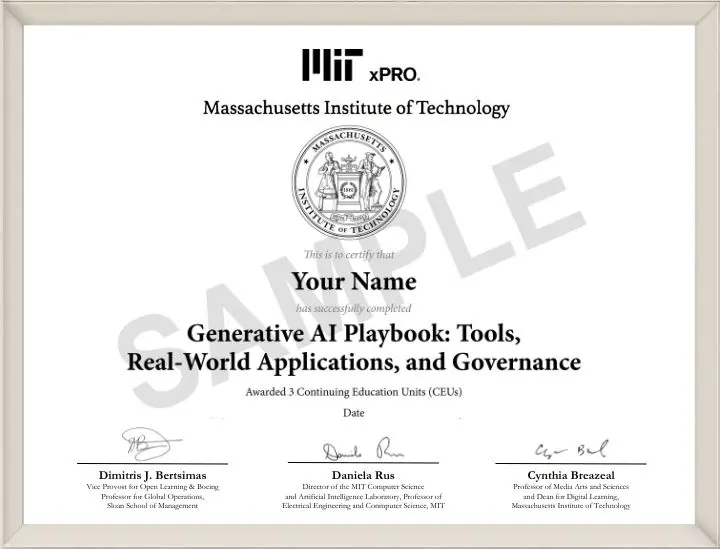
Certificate
Get recognized! Upon successful completion of this program, you receive 3 Continuing Education Units, a globally recognized measure of professional learning that reflects compliance with international quality standards, and a certificate of completion from MIT xPRO.
This program is graded as a pass or fail; participants must receive 70% to pass and obtain the certificate of completion.
Note: After successful completion of the program, your verified digital certificate will be emailed, at no additional cost, in the name you used when registering for the program. All certificate images are for illustrative purposes only and may be subject to change at the discretion of MIT xPRO.
Receive an executive certificate with this learning journey
Executive Certificate in AI-Led Business Transformation
Lead End-to-End AI Transformation
Experience a comprehensive learning journey with MIT xPRO, combining two popular executive programs to enhance your expertise in the new world of AI. This integrated approach blends cutting-edge AI insights with strategic leadership frameworks, equipping professionals to develop AI-driven products, implement AI solutions at scale, and lead transformation within their organizations.


FAQs
1
What is the Generative AI Playbook: Tools, Real-World Applications, and Governance program from MIT xPRO?
The Generative AI Playbook: Tools, Real-World Applications, and Governance program from MIT xPRO is a six-week online generative AI certificate program designed to help professionals build disciplined judgment in generative AI. This generative AI program explores real-world applications, core generative AI concepts, and responsible evaluation of AI systems, equipping participants with practical insight into how modern generative AI technologies function in business contexts.
2
Is this generative AI course worth it?
This generative AI course is valuable for professionals who want more than surface-level familiarity with artificial intelligence. The program emphasizes applied generative AI, real-world case analysis, and responsible evaluation of generative AI models, helping participants strengthen AI skills and make informed decisions as the job market increasingly demands clarity in AI adoption.
3
Who is this applied generative AI program for?
This applied generative AI program is designed for professionals across industries who need a solid understanding of how generative AI continues to shape decisions, workflows, and outcomes. It is particularly suited for those responsible for evaluating AI workflows, influencing AI strategy, or assessing generative AI solutions, without requiring prior coding or technical expertise.
4
What skills will I gain from this generative AI certificate program?
Participants will develop generative AI skills grounded in real-world applications. The curriculum strengthens understanding of large language models (LLMs), generative models, and machine learning (ML) foundations while emphasizing ethical considerations, AI governance, and responsible deployment. Through structured exercises and hands-on projects, learners will gain practical skills to evaluate opportunities and risks confidently.
5
Does the program cover large language models (LLMs) and retrieval-augmented generation(RAG)?
The curriculum explores how large language models (LLMs) function within modern AI systems, including concepts such as retrieval augmented generation (RAG). You will examine how these approaches influence AI workflows, decision-making processes, and real-world applications of generative AI.
6
Will I learn about AI agents and agentic AI?
The program introduces AI agents and the emerging role of agentic AI within enterprise environments. You will evaluate how these systems interact with users, automate workflows, and raise new ethical considerations and governance challenges in evolving AI technologies.
7
Is this generative AI course technical?
This is not an AI development or coding-focused AI course. Instead, it is an applied generative AI course designed to build a basic understanding of critical AI mechanisms, including neural networks, deep learning, and natural language processing, so you can evaluate systems responsibly without writing code.
8
Does the program include hands-on experience?
The program includes structured exercises, applied analysis, and hands-on project work designed to translate conceptual knowledge into practical evaluation skills. Through guided assignments and project discussion forums, participants gain an applied perspective without engaging in full-scale system builds.
9
How much does the program cost?
The course fee and full program details are listed on the official MIT xPRO page. The fee includes access to course materials, structured learning resources, and program support throughout the six-week experience.
10
What is the best generative AI program?
The best generative AI program depends on your goals. If you are looking to build practical judgment rather than technical coding expertise, a strong option is a structured generative AI certificate program, such as the Mastering Generative AI Applications program from MIT xPRO, that focuses on applied generative AI, responsible deployment, and real-world evaluation of AI systems. Programs that combine conceptual depth with hands-on projects and clear program outcomes are typically most valuable for professionals navigating AI-driven change.
11
Is ChatGPT a generative AI?
ChatGPT is an example of generative AI built on large language models (LLMs). It uses advanced generative models to produce human-like text, assist with creating new content, and support various applications of generative AI across industries.
12
Is there a free generative AI tool?
There are free tools that allow limited access to generative AI technologies, including conversational AI platforms and content generation tools. However, gaining a structured, responsible understanding of generative AI concepts, ethical considerations, and AI governance typically requires a formal gen AI course or guided learning experience.
13
How do I become a gen AI specialist?
Becoming a specialist in generative AI typically involves building a strong foundation in machine learning (ML), deep learning, and core generative AI concepts. You may also explore areas such as prompt engineering, AI agents, and retrieval augmented generation (RAG). Enrolling in an applied generative AI program, completing hands-on projects, and developing a disciplined understanding of AI governance and responsible deployment can help you build advanced knowledge and long-term expertise.
14
How does Emeritus support accessibility for learners?
Emeritus is committed to making high-quality education accessible and affordable to individuals, companies, and governments around the world. If you have questions about accessibility or would like to discuss available support options before enrolling, please contact accessibility@emeritus.org. For more information about our accessibility practices, please review our Accessibility Policy here.
Financing Options
Climb Credit*
We offer financing options with our partner, Climb Credit*. Click here to learn more.
Flexible Payment Options For All
Flexible payment options allow you to pay the program fee in installments. Click here to see payment schedule.
Didn't find what you were looking for? Write to us at learner.success@emeritus.org or Schedule a call with one of our Academic Advisors or call us at +1 401 443 9591 (US) / + 44 189 236 2347 (UK) / +65 3129 7174 (SG)
Flexible payment options available.
Starts On