
Executive Certificate in AI-Led Business Transformation
Connect AI, innovation, and leadership in one learning journey
Program Overview: Executive Certificate in AI-Led Business Transformation
The Executive Certificate in AI-Led Business Transformation is a seven-month learning journey from MIT xPRO designed to develop three connected AI capabilities: applying AI to real business challenges, building AI-powered products and services, and leading AI transformation. By integrating the Generative AI Playbook: Tools, Real-World Applications, and Governance program; the Designing and Building AI Products and Services program; and the AI Strategy and Leadership Program: Driving Data and Organizational Transformation, the learning journey brings these complementary capabilities together into one cohesive experience.
Through practical assignments, AI product development projects, strategy playbooks, and industry examples, you will progress from applying generative AI (gen AI) to developing AI-powered solutions and shaping AI strategy, governance, and organizational adoption. By the end of the program, you will be equipped to translate AI opportunities into real business outcomes and lead responsible AI initiatives with confidence.
Through practical assignments, AI product development projects, strategy playbooks, and industry examples, you will progress from applying generative AI (gen AI) to developing AI-powered solutions and shaping AI strategy, governance, and organizational adoption. By the end of the program, you will be equipped to translate AI opportunities into real business outcomes and lead responsible AI initiatives with confidence.


Three AI Capabilities. One Learning Journey
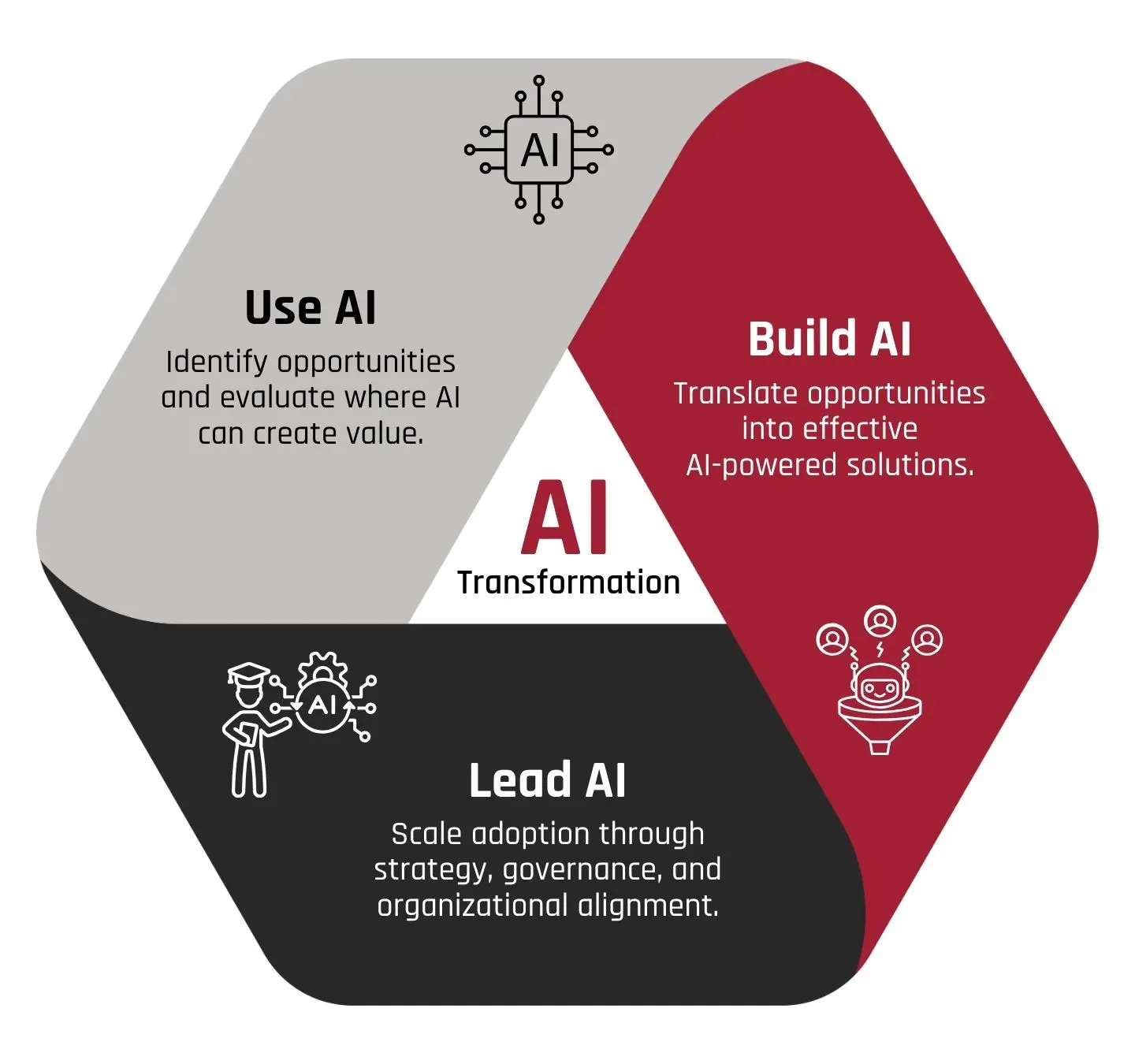
Most AI initiatives fail in the gaps between these capabilities. This learning journey is designed to connect them.
Key Takeaways
This connected MIT xPRO pathway develops end-to-end capabilities to apply gen AI, build AI-powered products and services, and lead AI transformation across your organization.
1
The Generative AI Playbook program enables you to:
Navigate the gen AI landscape and distinguish between generative models, machine learning (ML), and reinforcement learning
Apply image and text generative models to real-world business challenges
Leverage natural language processing (NLP) techniques to extract insights and solve practical problems
Assess ethical risks, biases, and governance issues in AI systems with confidence
Identify AI opportunities in areas such as fraud detection or predictive maintenance and develop practical solutions
Design and present a responsible gen AI solution tailored to a real challenge in your domain
2
The Designing and Building AI Products and Services program enables you to:
Classify and describe various ML algorithms, such as supervised, unsupervised, and reinforcement learning, highlighting their unique characteristics and applications
Distinguish between different types of neural networks, including convolutional neural networks (CNNs), deep neural networks (DNNs), and recurrent neural networks (RNNs), to explain their structures, functionalities, and use cases
Understand the architectures underlying transformer and other gen AI approaches to be able to critically assess when to use them in a given business context
Critically assess the four key stages of the AI design process, discussing their significance, challenges, and best practices for successful implementation
Explain how retrieval-augmented generation (RAG), chain-of-thought prompting, and tool integration extend the capabilities of transformers, enabling AI agents to reason more effectively, access external knowledge, and perform complex tasks across platforms
Analyze the interaction between humans and computers in AI systems, focusing on how human input, oversight, and collaboration enhance AI performance and decision making
Illustrate the concept of superminds — groups of individuals and machines working together — and how different configurations of superminds can effectively tackle diverse problems
Identify and forecast potential AI-driven opportunities within digital business processes, emphasizing areas where AI can drive innovation, efficiency, and competitive advantage
Develop a comprehensive business case for the initiation of an AI application, including cost-benefit analysis, strategic alignment, risk assessment, and an implementation road map
3
The AI Strategy and Leadership Program enables you to:
Develop an AI strategy that aligns with organizational goals, drives business value, and enhances competitive advantage
Design a data strategy that enables effective AI integration, scalability, and responsible data use
Evaluate organizational readiness for AI adoption across leadership, processes, and culture
Apply governance frameworks that ensure transparency, accountability, and the ethical management of AI risks, including privacy, bias, and security
Integrate data-driven insights and AI tools into leadership decision making, communication, and performance management
Develop initiatives that cultivate an adaptive culture of innovation, agility, and sustainable AI transformation
Who Is the Executive Certificate in AI-Led Business Transformation For?
This learning journey prepares professionals to navigate the evolving AI landscape and create meaningful organizational impact. It is ideal for you if you want to:
Strengthen your AI expertise
Build the confidence to drive AI initiatives within your organization
Develop practical skills for creating AI-powered solutions
Better align AI with business priorities
Note: Previous knowledge of calculus, linear algebra, statistics, and probability is beneficial, along with basic Python experience, particularly for the AI product development components of the program.
What Will You Learn in the Executive Certificate in AI-Led Business Transformation?
Designed to build end-to-end AI capabilities, the curriculum combines practical AI applications, product innovation, and enterprise leadership into a cohesive learning experience. You will develop a strong understanding of AI technologies, product development methodologies, governance frameworks, and organizational strategies while applying your learning through practical assignments and real-world business scenarios. By the end of the program, you will be equipped to translate AI opportunities into scalable solutions and lead AI transformation with confidence.
1
1 — Generative AI Playbook
Module 1: Gen AI and the AI Landscape
Module 2: Gen AI for Visual Data and Image Outputs
Module 3: Gen AI for Text Data and Text Generation
Module 4: Ethics and Governance in AI
Module 5: AI in Practice — Applications and Case Studies
Module 6: Future of AI and Course Wrap-Up
2
2 — Designing and Building AI Products and Services
Module 1: Introduction to the Artificial Intelligence Design Process
Module 2: Artificial Intelligence Technology Fundamentals — Machine Learning
Module 3: Artificial Intelligence Technology Fundamentals — Deep Learning
Module 4: Designing Artificial Machines to Solve Problems
Module 5: Generative AI
Module 6: Designing Intelligent Human–-Computer Interaction (HCI)
Module 7: Superminds: Designing Organizations That Combine Artificial and Human Intelligence
Module 8: Marketplace Frontiers of AI Design: Research
Module 9: Marketplace Frontiers of AI Design: Practice
3
3 — AI Strategy and Leadership Program
Phase 1: Building AI and Data Foundations
Module 1: AI Strategy
Module 2: Leveraging Data for AI
Module 3: Data Strategy
Module 4: Deployment and Insights
Module 5: Understanding AI Risks
Module 6: Data Privacy
Phase 2: Leading AI Transformation
Module 7: AI and Leadership
Module 8: Architecting a Nimble Organization
Module 9: Architecting the Game Bboard at the Team Level
Module 10: Developing Your Leadership Signature
Module 11: AI Governance
Module 12: Culture of Innovation
Note: The topics are indicative and subject to change based on speaker availability.
Credentials That Set You Apart
Complete your learning journey with achievements that demonstrate the depth of your AI expertise and commitment to continuous professional development.
Live Sessions with MIT Faculty
LLMs, Agents, and the State of Gen AI Today
Designing Responsible Autonomous Agents for Real-World Applications
The Agentic AI Landscape — Present and Future
Emerging Standards for Agentic AI — Model Context Protocol and Beyond
Case Study — Building an Agentic Platform from the Ground Up
Pitfalls of AI — The Strategic and Operational Risks of Deepfakes
Do Not Wait for Perfect, Act with Purpose — Building Strategic Advantage in the Imperfect Gen AI Era
Human–AI Collaboration for Innovation — Real-World Insights and Strategy Development
Surviving and Thriving in the New World of AI
Note: The topics are indicative and subject to change based on speaker availability.
Practical Experience with Popular AI Tools
Gain practical experience with leading AI tools through hands-on activities designed to strengthen your AI fluency and help you apply AI with greater confidence in real-world scenarios.
ChatGPT: Build with advanced conversational AI
Claude: Create with high-context AI reasoning
Google Gemini: Explore multimodal AI capabilities
Applied Strategy Playbook
Work through structured playbook activities that provide step-by-step guidance for applying AI strategy, strengthening data governance, developing leadership capabilities, and translating an innovation culture into practical organizational action.
Data management in your organization
An AI strategy road map
Responsible AI in your organization
Federated data
AI tools for leadership
Organizational analysis
X-teams
Assessing your leadership strengths and weaknesses
Culture strategy
Capstone Experiences
Demonstrate your learning through capstone experiences that bring together AI strategy, governance, leadership, and organizational transformation. By addressing realistic business challenges, you will develop practical solutions that prepare you to lead AI initiatives and create lasting organizational impact.
Addressing a leadership challenge
Designing a more adaptable organization
Leveraging AI and x-teams
Leadership and team capabilities
Leadership responsibility
Creating your strategic plan
Program Highlights

In-Demand AI Capability Development

A Complete AI Learning Pathway

Real-World Exposure

Business-Focused AI Leadership

Applied Learning Experience

Live Online Sessions

MIT Faculty Expertise

Globally Recognized Credentials

A Diverse Global Network
Meet the Faculty

Antonio Torralba
Professor of Electrical Engineering and Computer Science and Faculty Director, MIT; Director, MIT-IBM Watson AI Lab; Director, MIT Quest for Intelligence
From 2000 to 2005, Antonio Torralba spent his postdoctoral training at the Brain and Cognitive Sciences Department and the Computer Science and Artificial Intelligence Laborat...

Daniela Rus
Professor of Electrical Engineering and Computer Science and Faculty Director, MIT
Daniela Rus is the Andrew (1956) and Erna Viterbi Professor of Electrical Engineering and Computer Science (EECS). Her research interests are in robotics, mobile computing, an...

Asu Ozdaglar
Professor of Electrical Engineering and Computer Science and Deputy Dean of Academics, MIT
Asu Ozdaglar’s research focuses on the technical and societal aspects of large-scale, data-driven systems. Her expertise includes optimization, ML, economics, and networks. In...

Cynthia Breazeal
Professor of Media Arts and Sciences and Dean for Digital Learning, MIT
Cynthia Breazeal founded and directs the Personal Robots group at the MIT Media Lab. In her role as dean for digital learning, she leverages her experience in emerging digital...

Yoon Kim
Associate Professor, Department of Electrical Engineering and Computer Science, MIT
Yoon Kim is the NBX Career Development Professor and is affiliated with CSAIL. Kim conducts research in NLP and ML. He is interested in developing efficient methods for traini...

Phillip Isola
Associate Professor, Department of Electrical Engineering and Computer Science, MIT
Phillip Isola studies computer vision, ML, robotics, and AI. His current research focuses on trying to scientifically understand humanlike intelligence. Isola's research has b...

Armando Solar-Lezama
Professor of Computing; Associate Director and COO, CSAIL, MIT
Professor Armando Solar-Lezama leads the Computer-Aided Programming Group at MIT and aims to reduce the skill and effort required to develop software that is secure, reliable,...

Regina Barzilay
School of Engineering Distinguished Professor of AI and Health, Department of Electrical Engineering and Computer Science, MIT; AI Faculty Lead, MIT Jameel Clinic
Regina Barzilay develops ML methods for drug discovery and clinical AI. In the past, she worked on NLP. Her research has been recognized with the MacArthur Fellowship, an NSF ...

Wojciech Matusik
Professor of Electrical Engineering and Computer Science, CSAIL, MIT
Wojciech Matusik leads the Computational Design and Fabrication Group and is a member of the Computer Graphics Group. His research interests are in computer graphics, computat...

Zachary Liberman
Adjunct Associate Professor of Media Arts and Sciences, MIT
Zachary Liberman is an artist, researcher, and educator with a simple goal: He wants you to be surprised. In his work, he creates performances and installations that take huma...

Pattie Maes
Germeshausen Professor of Media Arts and Sciences, MIT Media Lab
Pattie Maes runs the Fluid Interfaces research group, which conducts research in HCI and AI with a focus on applications in health, well-being, and learning. Maes is also a fa...

Dylan Hadfield-Menell
Associate Professor, Electrical Engineering and Computer Science, MIT
Dylan Hadfield-Menell runs the Algorithmic Alignment Group in CSAIL and is also a Schmidt Sciences AI2050 Early Career Fellow. His research develops methods to ensure that AI ...

Marzyeh Ghassemi
Associate Professor, Electrical Engineering and Computer Science and the Institute for Medical Engineering & Science, MIT
Dr. Marzyeh Ghassemi is a Vector Institute faculty member, holding a Canadian CIFAR AI Chair and a Canada Research Chair. She holds MIT affiliations with the Jameel Clinic and...

Dr. Anastasia Kouvaras Ostrowski
Assistant Professor, Purdue University
Dr. Anastasia Kouvaras Ostrowski is an assistant professor in the School of Applied and Creative Computing, with a courtesy appointment in the School of Mechanical Engineering...

Brian Subirana
Former Director, MIT Auto-ID lab
Brian Subirana has taught at MIT Sloan School of Management and the MIT School of Engineering and is also on the faculty of Harvard University. His research centers on the Int...

Andrew Lippman
Senior Research Scientist, MIT; Associate Director, MIT Media Lab
Andrew Lippman heads the Viral Communications research group at MIT Media Lab. His work ranges from digital video and entertainment to graphical interfaces, networking, and bl...

Alex “Sandy” Pentland
Faculty Director, MIT Connection Science Research Initiative; Toshiba Professor of Media Arts and Sciences, MIT; Center Fellow, Stanford Institute for Human-Centered Artificial Intelligence
Professor Alex “Sandy” Pentland has helped create and direct the MIT Media Lab and Media Lab Asia in India. He is one of the most-cited computational scientists in the world,...

Deborah L. Ancona
Seley Distinguished Professor of Management; Professor of Organizational Studies; Founder, MIT Leadership Center, MIT Sloan
Deborah L. Ancona’s pioneering research on how successful teams operate highlights the importance of managing both outside and inside team boundaries. This work led to the con...
Guest Speakers

David Anderton-Yang
Chief Executive Officer, Voomer

Aruna Sankaranarayanan
Research Assistant, MIT Media Lab

Matias Alba
Head of Customer Experience and Innovation, EarnIn

Tammy Savage
CEO and Cofounder, Groopit

Jeffrey Saviano
Senior Lecturer, MIT Sloan

David Krackhardt
Professor of Organizations, Heinz College of Public Policy and Management and Tepper School of Business, Carnegie Mellon University
Certificate
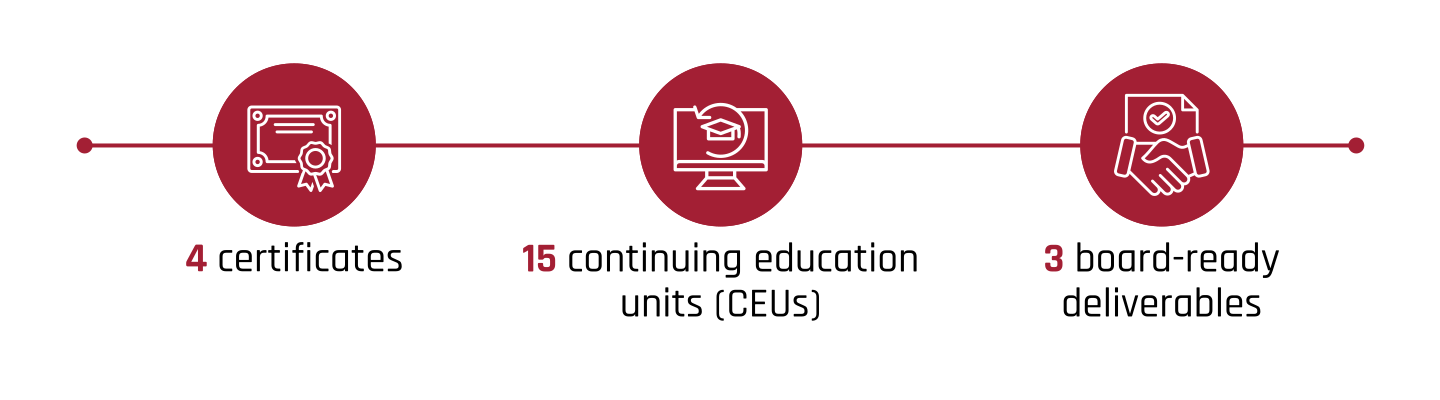
Upon successful completion of this program, you will receive four digital certificates from MIT xPRO and 15 CEUs, a globally recognized measure of professional learning that reflects compliance with international quality standards. The certificates include one each for the Generative AI Playbook: Tools, Real-World Applications, and Governance program; the Designing and Building AI Products and Services program; the AI Strategy and Leadership Program: Driving Data and Organizational Transformation; and the Executive Certificate in AI-Led Business Transformation.
The programs are graded as a pass or fail; you must receive 70% to pass and obtain the certificates.
The programs are graded as a pass or fail; you must receive 70% to pass and obtain the certificates.

Note: After the successful completion of this learning journey, verified digital certificates will be emailed to you, at no additional cost, with the name used when registering for the program. All certificate images are for illustrative purposes only and may be subject to change at the discretion of MIT xPRO.
FAQs
1
What is the Executive Certificate in AI-Led Business Transformation?
The Executive Certificate in AI-Led Business Transformation is an executive AI learning journey from MIT xPRO that prepares professionals to apply AI, develop AI-powered products and services, and lead AI initiatives across organizations. By integrating the Generative AI Playbook: Tools, Real-World Applications, and Governance program; the Designing and Building AI Products and Services program; and the AI Strategy and Leadership Program: Driving Data and Organizational Transformation, this connected learning pathway provides a comprehensive understanding of AI technologies, product innovation, and enterprise leadership.
2
What will I learn in this AI transformation learning journey?
The learning journey explores the technologies, tools, and leadership approaches needed to translate AI into meaningful business outcomes. You will gain exposure to gen AI, AI product development, governance, data strategy, and business applications while working with practical frameworks, hands-on activities, and industry examples that strengthen your ability to develop a generative AI strategy and make informed decisions in an emerging technology landscape.
3
Who should enroll in this executive AI learning journey?
This learning pathway is designed for business professionals, business leaders, business executives, and senior executives who want to strengthen their AI expertise and prepare for evolving leadership roles. Whether you work in strategy, technology, product management, consulting, operations, or innovation, the curriculum helps develop strategic thinking and the practical knowledge needed to lead AI initiatives with confidence. The learning journey is best suited for professionals with prior knowledge of calculus, linear algebra, statistics, and probability. Basic Python experience is also beneficial.
4
What is the best AI program for executives?
The best AI program for executives should extend beyond AI fundamentals and help leaders understand how AI influences business strategy, innovation, governance, and organizational decision making. This MIT xPRO learning journey combines three executive AI programs, integrating AI application, product development, and leadership to prepare professionals to lead digital transformation while benefiting from valuable networking opportunities with a diverse global cohort.
5
Why is AI transformation important for business leaders?
AI transformation is no longer limited to technology teams. It is reshaping how organizations innovate, develop products, improve operations, and make strategic decisions. For business leaders, the ability to harness AI effectively is becoming essential to identify new growth opportunities, guide responsible AI adoption, and align AI initiatives with long-term business strategy.
6
How can an organization build a successful AI strategy?
Building a successful AI strategy requires aligning technology initiatives with organizational priorities, governance, and long-term business goals. This learning journey introduces proven approaches for integrating AI into business strategy, applying practical frameworks, and developing responsible AI practices that support sustainable growth and enterprise-wide adoption.
7
What does it take to build AI-powered products and services?
Building AI-powered products requires a strong understanding of user needs, AI technologies, product design, and responsible implementation. Through practical learning, the learning journey explores modern AI product development approaches that help you create innovative business applications, evaluate AI systems, and translate ideas into scalable solutions.
8
How does this learning journey help professionals apply AI in real-world business environments?
The learning journey integrates AI-driven assignments, product design projects, strategy playbooks, capstone experiences, and industry examples to help professionals apply AI across the innovation life cycle. Through hands-on experience, participants will design AI-powered solutions, develop AI strategies, evaluate responsible AI practices, and solve real business challenges, preparing to translate AI concepts into measurable organizational outcomes.
9
How can gen AI create business value across industries?
The greatest value from gen AI comes when organizations can move beyond experimentation to practical implementation. This pathway prepares you to evaluate AI opportunities, develop AI-powered business applications, and lead responsible adoption across the enterprise. By combining gen AI strategy, product innovation, and organizational leadership, the learning journey helps you translate AI potential into measurable business outcomes.
10
Is the Executive Certificate in AI-Led Business Transformation worth it?
If you want to build expertise beyond AI fundamentals, this pathway offers a comprehensive learning experience that combines AI application, product development, and enterprise leadership. Through expert-led instruction, real-world projects, exposure to practical frameworks, and insights into new technologies, you will be better prepared to lead AI initiatives, support organizational innovation, and accelerate your professional growth.
Didn't find what you were looking for? Write to us at learner.success@emeritus.org or schedule a call with one of our Program advisors or call us at +1 401 443 9591 (U.S.) / + 44 189 236 2347 (U.K.) / +65 3129 7174 (SG).
Flexible payment options available.
Starts On