

Certificate Program in AI Product Design and Robotics Applications
Build the Two Capabilities Defining the Future of Tech
Program Overview: Certificate Program in AI Product Design and Robotics Applications
The Certificate Program in AI Product Design and Robotics Applications from MIT xPRO is a five-month program that builds technical fluency in AI product development and robotics. The learning journey combines two expert-led MIT xPRO programs — Designing and Building AI Products and Services and Robotics Essentials — equipping technical professionals and leaders to design, evaluate, and deploy the next wave of intelligent systems.
As automation accelerates across industries, organizations urgently need talent that can navigate both fragmented robotics stacks and fast-evolving AI capabilities and pilot reliable, scalable solutions. Through self-paced learning, applied projects, and live sessions with expert MIT faculty, you will discover how robotic systems work — from sensing and control to autonomy and human–robot interaction (HRI) — alongside the frameworks needed to build AI-driven products and features. You will gain helpful insights on how to assess feasibility, articulate system behavior, and shape automation initiatives with both technical depth and strategic clarity, positioning yourself to drive innovation across domains.
Who Is the Certificate Program in AI Product Design and Robotics Applications For?
The Certificate Program in AI Product Design and Robotics Applications from MIT xPRO is designed to equip professionals in the technology space, product development, and innovation with practical expertise in AI product design and robotics. It is ideal for:
Product managers, designers, and UX practitioners who need clear frameworks in AI product design and foundational robotics knowledge to create feasible, human-centered solutions
Engineering and technical professionals who want a deeper understanding of AI and robotics to lead high-impact automation projects, advance their careers, and stay competitive
Technical leaders, innovators, directors, and enterprise architects who want to lead automation initiatives with clarity, ground decision making in technical fluency, and evaluate ROI with confidence
Entrepreneurs, consultants, and advisors across sectors, including healthcare, logistics, construction, energy, and aviation, who seek hands-on training to build technical credibility, identify high-value use cases, and design scalable solutions
Note: The content of this program assumes previous knowledge of calculus, linear algebra, statistics, and probability. Basic Python experience will also be beneficial.
Program Highlights
By combining the curriculum of MIT xPRO’s two online programs — Robotics Essentials and Designing and Building AI Products and Services — the Certificate Program in AI Product Design and Robotics Applications delivers a unique learning journey that strengthens your capabilities in both domains. Gain cutting-edge insights on how to understand system behavior, design viable AI-driven solutions, and contribute confidently to automation initiatives across technical and organizational contexts.

Cost and Time Efficiency
Save on individual program costs while benefiting from an integrated learning journey designed to maximize your ROI in less time.

Dual Expertise
Develop practical skills in both AI product design and robotics essentials, enabling yourself to move beyond siloed roles and lead intelligent automation initiatives that span the entire stack.

Real-World Application
Gain hands-on training in building intelligent solutions through simulations, design activities, and a capstone-ready project proposal you can present to internal stakeholders or investors.

Enhanced Career Potential
Stand out in a high-growth industry with dual expertise in building scalable AI solutions and robotics initiatives.

Expert-Led Live Sessions on AI
Gain insights on retrieval-augmented generation (RAG), agentic AI, and future AI trends in live sessions with renowned MIT faculty.

Credibility and Prestige
Earn three certificates and 16 Continuing Education Units from MIT xPRO, demonstrating your advanced expertise in AI product design and robotics to employers and peers.
What You Will Learn in the Certificate Program in AI Product Design and Robotics Applications
The MIT xPRO Certificate Program in AI Product Design and Robotics Applications offers a comprehensive curriculum that spans robotics fundamentals and AI product design. Progress from designing and evaluating machine learning and generative AI capabilities to understanding key robotics foundations, including sensing, control methods such as proportional-integral-derivative (PID), linear quadratic regulator (LQR), and model predictive controller (MPC), as well as HRI. Through self-paced modules, interactive exercises, and a final capstone proposal, you will build the skills to deploy viable, AI-based solutions that address real organizational needs.
1
Part 1 — Designing and Building AI Products and Services
Week 1: Orientation Week
Gain access to the learning platform from the program start date, familiarize yourself with the classroom environment, and prepare for the learning journey ahead.
Week 2: Introduction to the Artificial Intelligence Design Process
Explore the stages involved in designing an AI-based product with a focus on key considerations, including cost metrics and the technical requirements of an AI software development plan.
Week 3: Artificial Intelligence Technology Fundamentals: Machine Learning
Identify key machine learning algorithms and examine different approaches, including Bayesian and regression models. Explore unsupervised and semi-supervised learning methods, and run and analyze the outputs of multiple machine learning algorithms. Additionally, explore AI applications in uncovering genetic disease predispositions.
Week 4: Artificial Intelligence Technology Fundamentals: Deep Learning
Study deep learning fundamentals, including neural networks, artificial neurons, and complex system simulations. Explore Dr. Regina Barzilay’s work on AI-enabled breast cancer detection, and examine Tempo, an AI detection application deploying multimodality.
Week 5: Designing Artificial Machines to Solve Problems
Analyze examples of superhuman intelligence in AI products, and assess the benefits and limitations of various AI technologies. Study AI system design and implementation, including avatar creation through image generation and voice cloning.
Explore transformer-based natural language processing (NLP) architectures, from tokenization to vector representation, and examine how generative AI capabilities change when decoders are introduced. Review a case study on AI limitations in gynecological decision making, evaluate errors in image and language generation, and consider technical approaches to mitigate these issues.
Week 6: Generative AI
Discover AI applications, ranging from NLP embeddings and prompt engineering to benchmarking, process optimization, and expert decision support. Study RAG and chain-of-thought prompting, and apply these techniques through an interactive chatbot assignment focused on RAG system design.
Week 7: Designing Intelligent Human–Computer Interfaces (HCI)
Explore HCI methods, application contexts, advantages, and limitations. Define appropriate levels of machine involvement in human–computer interactions, and identify opportunities to apply AI effectively within interface design.
Week 8: Superminds — Designing Organizations That Combine Artificial and Human Intelligence
Examine the concept of superminds, and compare different models of collective intelligence. Analyze how human and machine collaboration can outperform individual efforts, and apply cognitive frameworks to organizational and community challenges.
Week 9: Marketplace Frontiers of AI Design: Research
Study the use of AI and generative adversarial networks (GANs) to generate fake images and videos from real data. Evaluate the technical, social, and economic impacts of emerging AI technologies.
Week 10: Marketplace Frontiers of AI Design: Practice
Apply the Lawler Model to define an AI problem, and develop a structured summary of an AI product or process using insights gained throughout the program.
2
Part 2 — Robotics Essentials
Week 1: Orientation Week
Access the learning platform from the program start date and orient yourself to the classroom environment in preparation for the learning journey.
Week 2: Why Automation and Robotics?
Study the fundamentals of robotics and automation to evaluate adoption opportunities and implementation barriers. Analyze the influence of society on automation technologies, compare human and robot strengths, and examine how robotics creates value across workplaces and society.
Week 3: Design and Development of Robots
Examine robotic subsystems and architectural paradigms, and understand the roles of sensing, planning, and control in full robotic systems. Review robotic hardware components, assess levels of autonomy and their trade-offs, and identify the skills and key considerations required for full-stack robotics development.
Week 4: Sensing and Perception
Analyze the role of sensors in robotic architectures and how they enable task execution. Evaluate the impact of models on perception, describe the sensing process, and identify sensing hardware and the data it collects.
Week 5: Robot Decision Making
Explore task planning and decision-making processes used in robotic systems. Examine hierarchical planning approaches, define planning models based on key characteristics, and categorize different types of planning problems.
Week 6: Motion Planning and Trajectory Generation
Study motion planning applications — including manipulation planning and navigation planning — and their integration into robotic systems. Compare sample-based and optimization-based planning methods, and assess how machine learning can enhance planning performance.
Week 7: Establishing Control
Review the principles governing robot movement and performance. Define the components of a control problem, explore PID, LQR, and MPC applications, and compare the strengths and limitations of different control strategies.
Week 8: Concurrency and Real-Time Systems
Examine concurrency challenges in robotic systems, and apply real-time scheduling principles to manage task sequencing within time constraints. Analyze concurrency-related failures, apply scheduling algorithms, and review robot networking fundamentals.
Week 9: Human–Robot Interaction (HRI)
Complete a thorough examination of HRI, its purpose, and its challenges in real-world settings. Differentiate between HRI categories, examine outcomes and side effects, and assess safety considerations in robotic deployments.
Week 10: The Present and Future of Robotics
Explore automation approaches and characteristics that benefit specific robotic systems. Analyze emerging trends in robotics, distinguish between hard and soft automation, and articulate a vision for robots interacting with society in the future.
Note: The program topics are subject to change.
Live Sessions on AI
Agentic AI, RAG, and the Future of Scalable AI
Led by Dr. Brian Subirana, this live session examines AI agents, RAG, the Model Context Protocol (MCP), and scalable AI system design. Through real-world examples, including open-source LLMs and case studies from LangChain and Amazon, the session addresses technical best practices, deployment challenges, and emerging trends shaping intelligent AI systems.
Note: Live session content is subject to change. Topics on agentic AI and RAG complement the core module instruction.
Assignments and Projects
Develop Intuition: Explore various robotic capabilities through interactive scenarios.
Crowdsourcing: Build an understanding of real-world robotic applications through crowdsourcing and design simulation exercises.
Course Workbook: Record reflections for each lesson, and make plans to integrate full-stack robotics into your career or organization.
Try-It Activities: Test your understanding of key concepts in robotics through short interactive assessments.
Coding Exercises: Complete basic coding exercises across modules through simple activities using Jupyter Notebook.
Problem Solving Assigments: Apply insights learned to solve assigned problems from the workbooks provided at the end of certain modules.
Capstone Project: Create an AI design process model and develop a plan for an AI-based product or service.
Meet Our Faculty

Duane Boning
Clarence J. Lebel Professor, Electrical Engineering and Computer Science
Duane Boning is affiliated with the MIT Microsystems Technology Laboratories and serves as its associate director for computation and computer-aided detection. His research in...

Bruce Lawler
Managing Director, MIT Machine Intelligence for Manufacturing and Operations (MIMO)
Bruce Lawler is a technology entrepreneur and executive leader. As the managing director of MIT MIMO, Lawler focuses on improving revenue and resolving the data and operationa...

Andrew Lippman
Senior Research Scientist, MIT; Associate Director, MIT Media Lab
Andrew Lippman heads the Viral Communications research group at MIT Media Lab. His work ranges from digital video and entertainment to graphical interfaces, networking, and bl...

Thomas W. Malone
Patrick J. McGovern Professor of Management, MIT Sloan; Founding Director, MIT Center for Collective Intelligence
Thomas W. Malone is a professor of information technology and a professor of work and organizational studies at MIT. In his research over the years, Malone rightly predicted m...

Stefanie Mueller
X-Career Development Assistant Professor, MIT Electrical Engineering and Computer Science, joint with Mechanical Engineering
Stefanie Mueller is the head of the Human–Computer Interaction Community of Research at MIT Computer Science and Artificial Intelligence Laboratory. In her research, she devel...

Alberto Rodriguez
Associate Professor of Mechanical Engineering at MIT, Class of 1957 Career Development Professor
Alberto Rodriguez leads the Manipulation and Mechanisms Lab at MIT (MCube Lab), researching autonomous dexterous manipulation, robot automation, and end-effector design. He ha...

Julie Shah
Professor, Department of Aeronautics and Astronautics, MIT; Faculty Director, MIT Industrial Performance Center; Director, Interactive Robotics Group, MIT Computer Science and Artificial Intelligence Laboratory
Julie Shah’s work focuses on expanding the use of human cognitive models for AI. She has translated her work to manufacturing assembly lines, healthcare applications, transpor...

Brian Subirana
Former Director of the Auto-ID Lab, MIT
Brian Subirana's research centers on open standards for IoT and AI and focuses on manufacturing, e-learning, the creative industries, and digital health. He is developing a vo...
Guest Speakers

David Anderton-Yang
Chief Executive Officer, Voomer

Aruna Sankaranarayanan
Research Assistant, MIT Media Lab
Earn three distinguished certificates
Upon completion of this program, you will receive three digital certificates from MIT xPRO. These include certificates of completion for the Designing and Building AI Products, the Robotics Essentials program and Services program, and the Certificate Program in AI Product Design and Robotics Applications.
This program is graded as a pass or fail; participants must receive 70% to pass and obtain the certificate of completion.
This program is graded as a pass or fail; participants must receive 70% to pass and obtain the certificate of completion.
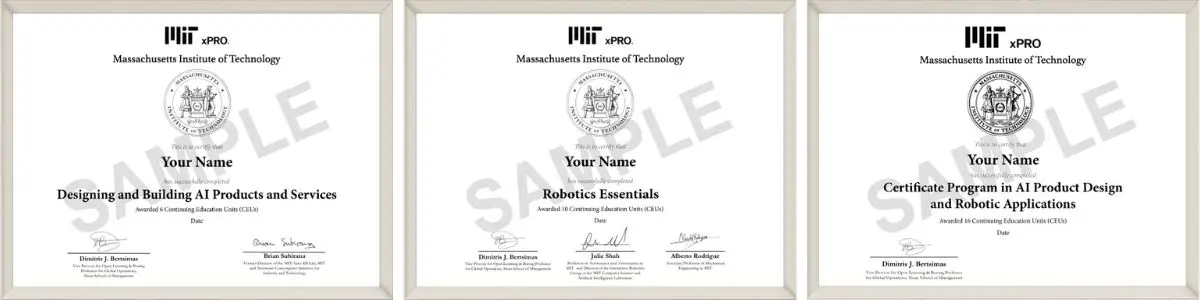
Note:
After the successful completion of the program, verified digital certificates will be emailed to participants, at no additional cost, with the name used when registering for the program
All certificate images are for illustrative purposes only and may be subject to change at the discretion of MIT xPRO
Why MIT xPRO?
Founded in 1861, the Massachusetts Institute of Technology (MIT) is committed to generating, disseminating, and preserving knowledge and to working with others to bring this knowledge to bear on the world’s great challenges. MIT is ranked #1 in Forbes’ America's Top Colleges list. MIT is dedicated to providing rigorous academic study, innovative research and scholarship, and a diverse campus community.
MIT’s motto, mens et manus (“mind and hand” in Latin), epitomizes the university’s dedication to education focused on practical solutions. Through MIT xPRO — one of the institute's online learning platforms — global executives can access vetted content from world-renowned experts anytime, anywhere. Designed using cutting-edge research in the neuroscience of learning, MIT xPRO programs are application-focused, helping business leaders build their skills on the job and in real time.
Frequently Asked Questions
1
Can I learn robotics on my own?
The Certificate Program in AI Product Design and Robotics Applications is designed for self-paced learning. It provides the structured foundations necessary to build confidence in robotics theory and systems, even without prior experience.
2
Is this program relevant for product managers and product leaders?
The Certificate Program in AI Product Design and Robotics Applications from MIT xPRO provides product managers and product leaders with the tools to turn user needs into AI-driven products, assess feasibility, and drive innovation using proven AI product frameworks.
3
Which program is best for robotics development?
The best program depends on your exact learning goals. The Certificate Program in AI Product Design and Robotics Applications from MIT xPRO provides learners with an understanding of robotics and AI-driven product development, supported by influential industry partnerships and case studies. Globally, students seeking excellence in technology look to MIT, where cutting-edge research meets advanced innovation across the disciplines of industrial engineering, electronics, mechanical design, and electrical and computer engineering.
4
How long will it take to learn robotics?
The Certificate Program in AI Product Design and Robotics Applications is completed within five months, providing a solid foundation in core concepts, including sensing, control, motion planning, and robot operating systems.
5
How do beginners learn robotics?
In the Certificate Program in AI Product Design and Robotics Applications, beginners build skills in robotics and AI product development through a structured pathway. By introducing concepts in a step-by-step manner, it guides you through fundamentals, real-world applications, and hands-on experiences to help you understand the mechanics of how robotic systems work.
6
What makes the learning experience different from an AI course?
The Certificate Program in AI Product Design and Robotics Applications combines AI product design with robotics essentials, offering a broader learning experience that connects AI technology, system design, and real-world implementation.
7
Will I learn about generative AI and modern AI tools?
You will explore generative AI, AI tools, RAG, agentic AI, and machine learning techniques in the Certificate Program in AI Product Design and Robotics Applications , with a focus on building and evaluating AI applications for real use cases.
8
How does this robotics course equip me to build real-world intelligent systems?
The Certificate Program in AI Product Design and Robotics Applications explores how robotic systems are designed and controlled, along with how artificial intelligence, machine learning, and tools such as generative AI can be applied to enhance autonomy, decision making, and product performance in real operations.
9
Does the curriculum include hands-on learning with AI tools and robotics system concepts?
In this robotics and AI product development program, you will engage in simulations, design activities, case studies, and applied exercises that cover robot design, sensing, motion planning, deep learning, and the integration of AI tools into real-world business contexts.
10
Is this an online robotics certificate designed for working professionals?
Unlike a traditional bachelor’s degree program, this program is delivered fully online with flexible weekly modules, making it easier for professionals to earn a certificate and new skills at their own pace, while balancing work and personal commitments.
11
What credentials do I earn from this Certificate Program in AI Product Design and Robotics Applications?
On completion of this AI product development and robotics program, students will receive three certificates of completion from MIT xPRO — each for the Robotics Essentials program, the Designing and Building AI Products and Services program, and the Certificate Program in AI Product Design and Robotics Applications — demonstrating verified expertise in robotics and artificial intelligence. It does not provide any official certificate or professional certificate.
12
What types of roles or teams can benefit from this program?
Engineers, product managers, product leaders, UX designers, and technical leaders working on robots, AI-driven products, computer vision, and system design can benefit from this program by building the hybrid specialization needed for emerging automation roles.
13
Which university is best for an AI program?
MIT has long set the benchmark for artificial intelligence learning, as well as leading robotics research that continues to redefine the possibilities of robotics engineering and intelligent decision making in real-world environments. With unrivaled access to innovation pipelines and global partnerships, learners interested in mastering advanced AI can expect an educational experience that is as prestigious as it is practical.
14
How does Emeritus support accessibility for learners?
Emeritus is committed to making high-quality education accessible and affordable to individuals, companies, and governments around the world. If you have questions about accessibility or would like to discuss available support options before enrolling, please contact accessibility@emeritus.org. For more information about our accessibility practices, please review our Accessibility Policy here.
Didn't find what you were looking for? Write to us at learner.success@emeritus.org or schedule a call with one of our Program advisors or call us at +1 401 443 9591 (U.S.) / + 44 189 236 2347 (U.K.) / +65 3129 7174 (SG).
Flexible payment options available.
Starts On