

AI-Driven Computational Design
Program Overview: AI-Driven Computational Design
MIT xPRO’s AI-Driven Computational Design is a seven-week online program that offers a practical exploration of AI-based design and manufacturing processes. Designed to bridge computational design theory with real-world engineering practice, the learning journey examines how generative AI, simulation, and optimization reshape the way products move from concept to production.
As AI tools evolve faster than most design workflows can absorb, engineering and manufacturing teams are often left choosing between outdated processes and fragmented, ad hoc AI experiments that lack rigor or reproducibility. Through key insights from leading MIT faculty and practical work with industry tools, including Fusion 360, ChatGPT, and Adobe Firefly, this program equips you with the skills to represent design spaces, predict performance using AI surrogate models, and translate optimized designs into manufacturing instructions for your organization.
Key Takeaways
This MIT xPRO program explores advanced AI and machine learning methods to develop AI-based designs of objects and physical experiments, produce manufacturing workflows, and convert digital designs into manufacturing instructions.
Explore how to create a smart design and manufacturing process by incorporating advanced AI and machine learning methods
Reduce manufacturing lead time through AI-driven industrial processes
Increase workforce productivity by introducing advanced digital design and manufacturing techniques
Learn how to predict design performance using virtual testing, numerical simulation, and AI surrogate methods
Reduce R&D costs by introducing AI/machine learning methods to convert performance-driven designs into manufacturable designs
Secure a competitive edge by enhancing technological efficiency, design accuracy, and manufacturing speed
Design 3D objects using generative design methods
Who Is the AI-Driven Computational Design Program For?
The MIT xPRO AI-Driven Computational Design program is ideal for:
Design and engineering professionals seeking to modernize product design and optimize manufacturing processes through AI-generated solutions
Manufacturing and production specialists looking to optimize production, enhance operations, improve resource utilization, and reduce costs
Product innovation and development experts looking to accelerate innovation cycles, create more personalized products, and stay ahead in competitive markets
Professionals from relevant fields that encompass consumer products, medical devices, electronics, architecture, and defense
What You Will Learn in the AI-Driven Computational Design Program
Module 1: Introduction to Computational Design
Describe and compare different types of design representation
Explain the analogy between design and programming
Create and manipulate objects in OpenSCAD
Discussion Forum: Opportunities and Challenges for Generative AI in Design Applications
Assignments:
Representing Designs Using Graphs
Basic Functions of OpenSCAD
Module 2: Design Spaces and Design Grammars
Understand formal grammars and procedural modeling
Describe applications for design grammars
Use geometric deformation methods for image/shape manipulation
Discussion Forum: Single Design vs. Design Space
Assignments:
Constructing a Design Space
Expanded Parametric Design Exploration
Module 3: Generative AI for Learning Design Spaces
Understand the differences between linear, nonlinear, diffusion, and large language models (LLMs)
Analyze use cases for data-driven models
Describe the challenges facing designers and engineers when integrating generative AI models into their workflows
Examine prompting techniques for refining LLM outputs
Discussion Forum: Large Language Models for Design
Assignment: Exploring Shoe Designs with an Autoencoder
Module 4: Mapping Design to Performance
Understand how to predict and optimize performance metrics for design configurations
Learn tools such as simulations, surrogate models, and LLMs for performance evaluation
Explore trade-offs between precision and efficiency in design evaluation workflows
Assignments:
LLM-Based Design Evaluation Simulation
Implementing a Surrogate Model to Estimate Design Performance
Building a Physics-Informed Neural Network for a Damped Harmonic Oscillator
Module 5: Inverse Design
Identify applicable reduced design spaces for inverse design
Understand the steps of topology optimization
Describe Bayesian optimization and identify potential applications
Assignments:
Bayesian Optimization for Black-Box Function Optimization
Design Optimization
Topology Optimization
Module 6: Generative AI for Creative Design
Understand the potential of generative AI to reshape creative design workflows
Define the challenges of balancing automation with human creativity
Describe how to incorporate these technologies into real-world applications
Assignment:
Using Generative AI Design Tools for Creative Design
Module 7: Generative AI for Digital Manufacturing
Explore how generative AI facilitates the translation of digital designs into actionable manufacturing instructions, bridging the gap between design and production
Learn to use AI-driven methods, including compilers and LLMs, to optimize fabrication workflows and increase manufacturing efficiency
Evaluate the potential of digital feedback loops and predictive models to improve product quality and sustainable manufacturing practices
Assignment:
Utilizing an LLM for Manufacturing Planning
Program Highlights

Practical Frameworks
Practice processes and methods through simulations, evaluations, case studies, and tools.

Global Network
Connect with an international community of professionals while working on projects based on real-world examples.

Flexible Online Learning
Access all content online and watch videos at your own pace — anytime, anywhere.

Real-World Application
Apply your newly acquired skills in your organization using examples from technical working environments and informed, practical advice.

Certificate of Completion
Earn a professional certificate and 5.6 continuing education units (CEUs) from MIT xPRO.

Learn from the Best
Gain insights from MIT faculty and industry experts, with one live session every two weeks.
What Does This Program Equip You to Do?
Understand how to develop an intelligent design and manufacturing workflow by integrating the latest AI and machine learning techniques
Learn how to represent parametric/procedural designs, and explore generative AI methods to represent design spaces (e.g., design families)
Delve into performance-driven design workflow and principles of generative and inverse design
Learn how to use machine learning for the design of physical experiments and design optimization
Learn the practical applications of AI tools, including Fusion 360, OpenSCAD, ChatGPT, Google Colab, and Adobe Firefly
Recognize the capabilities and limitations of current advanced manufacturing industry hardware
Meet the Faculty

Wojciech Matusik
Cadence Design Systems Professor of Electrical Engineering and Computer Science, Computer Science and Artificial Intelligence Laboratory (CSAIL), MIT
Wojciech Matusik is an Electrical Engineering and Computer Science (EECS) professor at MIT CSAIL, where he leads the Computational Design and Fabrication Group. He is the cofo...
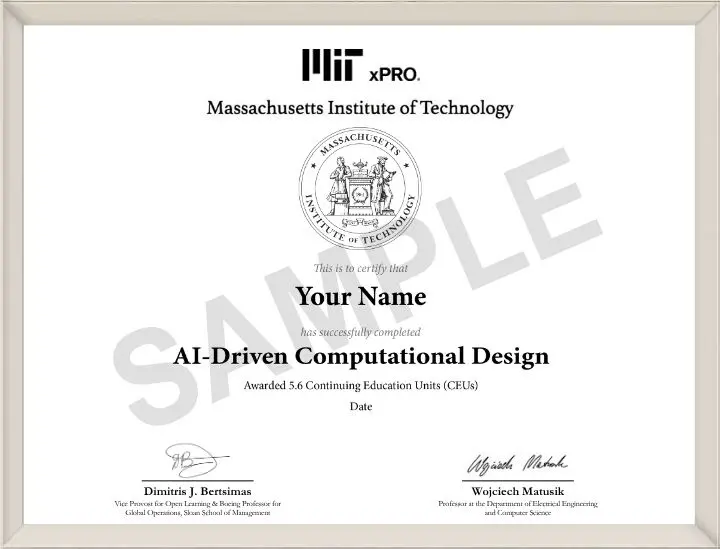
Certificate
Get recognized. Upon successful completion of this program, you will be granted a certificate of completion and 5.6 CEUs by MIT xPRO.
This program is graded as a pass or fail; you must receive 70% to pass and obtain the certificate of completion.
After successful completion of the program, your verified digital certificate will be emailed to you, at no additional cost, in the name you used when registering for the program. All certificate images are for illustrative purposes only and may be subject to change at the discretion of MIT xPRO.
A CEU is defined as 10 contact hours of ongoing learning to indicate the time devoted to a non-credit/non-degree professional development program. Please consult your training department or licensing authority to understand whether these CEUs may be applied toward professional certification, licensing requirements, or other required training or continuing education hours.
You are required to complete a CEU confirmation form based on the number of learning hours in each program to obtain CEUs.
Frequently Asked Questions (FAQs)
Is this AI in design course primarily intended for graphic designers or just for engineers?
The program is designed primarily for professionals involved in product design, engineering, manufacturing, and innovation functions. Participants build a solid understanding of how AI methods support computational design processes, simulation, optimization, and digital manufacturing workflows. While some concepts may be relevant to creating images or other creative work, the program's primary focus is engineering-driven design and product development.
How do I integrate AI into design work?
Using simple text prompts and AI workflows, you can describe ideas and concepts in plain language, and generative AI models turn them into images, media, and other visual assets. This gives you the ability to explore more options, faster and at a higher quality than manual methods.
Does the program cover advanced topics such as predictive modeling, digital twins, or real-time performance prediction?
The program introduces AI surrogate models that can efficiently predict design performance and support simulation-driven design workflows. These approaches share characteristics with digital twin technologies, although the program focuses primarily on design performance prediction and optimization.
What support will I get, and how do I track my progress?
You will get full access to video lectures, assignments, and online forums where you can connect with your peers and instructors. You will also receive feedback on assignments to track your progress and knowledge throughout the program, and you can always reach out to the program support team with more questions.
Who should take this AI in design course, and what career skills or software will they gain?
This program is built for design, engineering, and manufacturing professionals as well as early-career professionals and advanced learners looking to grow their careers in the age of AI effectively. You will gain practical experience in industry software, including Fusion 360, OpenSCAD, and ChatGPT, along with the skills needed to open new job opportunities with clients and teams across a wide range of engineering, product development, and manufacturing-intensive industries.
Unlike other online courses on generative AI skills, this program also covers the equally important ethical aspects of AI in design, so any person can apply these methods responsibly throughout their professional life.
How does Emeritus support accessibility for learners?
Emeritus is committed to making high-quality education accessible and affordable to individuals, companies, and governments around the world. If you have questions about accessibility or would like to discuss available support options before enrolling, please contact accessibility@emeritus.org. For more information about our accessibility practices, please review our Accessibility Policy here.
Financing Options
Climb Credit*
We offer financing options with our partner, Climb Credit*. Click here to learn more.
Flexible Payment Options For All
Flexible payment options allow you to pay the program fee in installments. Click here to see payment schedule.
Didn't find what you were looking for? Write to us at learner.success@emeritus.org or Schedule a call with one of our Academic Advisors or call us at +1 401 443 9591 (US) / + 44 189 236 2347 (UK) / +65 3129 7174 (SG)
Flexible payment options available.
Starts On